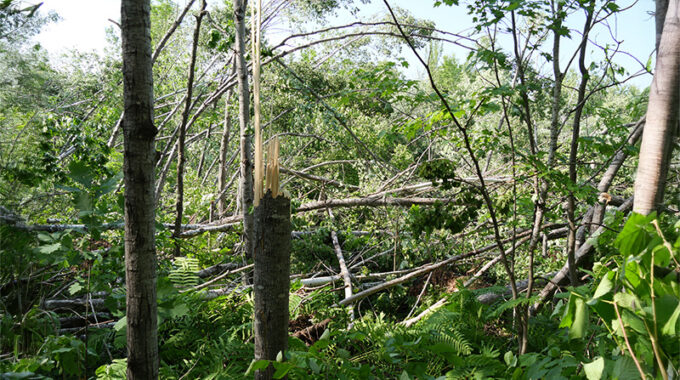
On June 21st of last year, a straight-line wind skipped across the Bayfield peninsula causing damage at Beaver Hollow. Salvage and remediation work has begun.
Proactively Addressing EAB
Emerald Ash Borer in Bayfield County
Emerald ash borer (EAB) was first identified in Bayfield County in April of 2022, in a Bayfield city park located just 4 miles from Beaver Hollow. Since its initial detection in southeastern Wisconsin in 2008, EAB has now been reported in all 72 counties of the state. The infestation is expected to result in the loss of 99% of ash trees statewide. Several FNPCW members were enrolled in a Northern Institute of Applied Climate Science (NIACS) forestry course at the time of this EAB discovery, and they proactively developed a comprehensive five-year forest recovery plan for the Friends’ property. The plan focuses on transitioning the black ash-dominated headwaters’ forest to stands of diverse native tree species that will thrive in this wetland habitat as the climate changes, will continue to support wildlife, and will preserve stream and Lake Superior water quality.
Managing an EAB Infestation
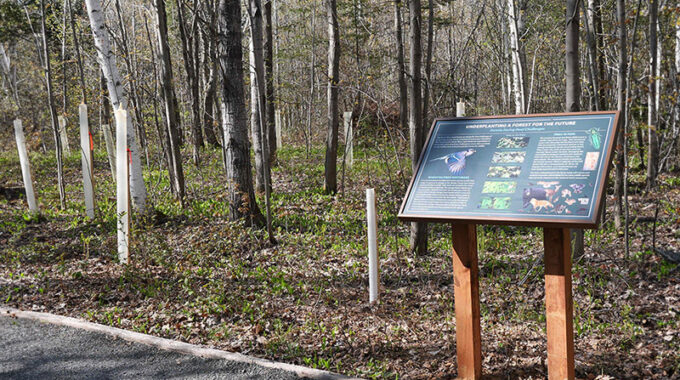
If not addressed, the death of ash trees surrounding the creek would lead to a cascading loss of the wetland forest. On average, a mature black ash tree absorbs about 63 liters of water from wetland soil each day through its roots. Without this transpiration process, the forest would become overly saturated, leading to the spread of less desirable, swamp-tolerant species such as invasive reed canary grass. In 2023, the Friends made an experimental planting of six native tree species to determine their suitability in the various soil types found on the property. In 2024 and 2025, community volunteers planted the species from the 2023 planting with the best survival rates, plus two species of disease resistant American elm. This spring, volunteers will plant a third disease resistant American elm species and swamp white oak in wet areas, and some walnut in drier soils. All trees planted are tubed to protect them from hungry deer and rabbits. To date, the survival rate of trees planted is more than 80%. The trees established in the understory today will gradually replace the ecological roles of the ash trees lost to EAB. Black ash trees along North Pikes Creek are already exhibiting signs of infection, including bark flecking and crown dieback. Continued efforts over the next few years aim to ensure a minimum of 25 healthy new trees per acre in the understory, maintaining transpiration, providing wildlife habitat, and safeguarding stream health.
Why Plant Elm?
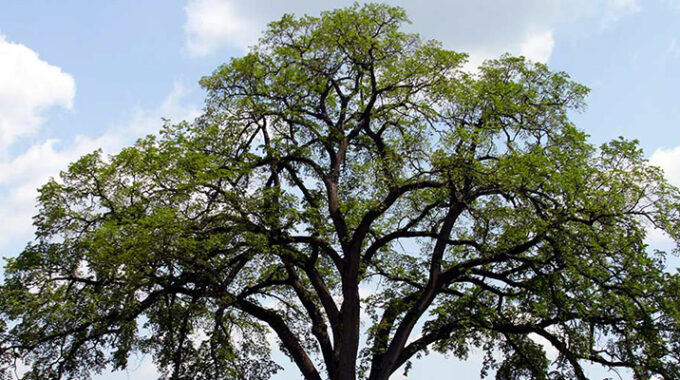
Prior to 1970, American elm trees were widespread in South Shore drainages, including North Pikes Creek. Elms and ash were the main trees growing in the bottomland soils, until these majestic elms were nearly extirpated by Dutch elm disease. Fortunately, a few “survivor trees” were identified – trees that remained heathy after Dutch elm disease moved through the area killing other elms. Researchers worked with these surviving individuals, and after many years, were able to develop several varieties of elm that are resistant to the Dutch elm disease.
The Friends are planting three species of these disease resistant elms in the North Pikes Creek drainages to replace the dying ash trees they once grew alongside, 50-some years ago. Elms are an important species for wildlife. They hold their seeds through the winter months, and are an important food source for spring migrating songbirds. Elms are one of the first trees to flower providing early season nectar for pollinators. The FNPCW is pleased to be able to reestablish this important tree species in the North Pikes Creek Watershed.
Related Posts