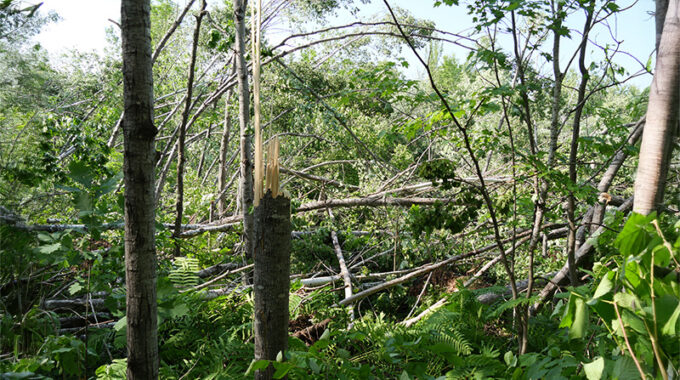
On June 21st of last year, a straight-line wind skipped across the Bayfield peninsula causing damage at Beaver Hollow. Salvage and remediation work has begun.
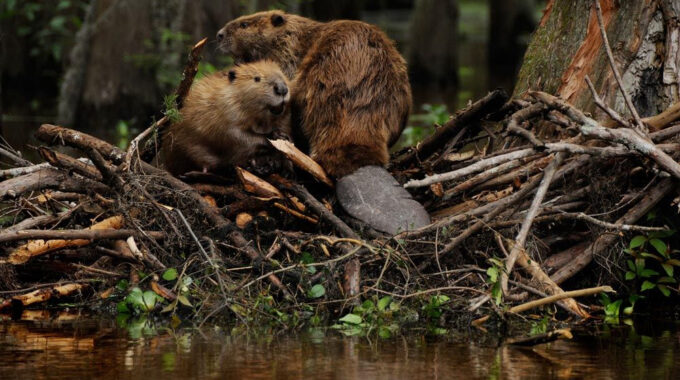
Beaver Management Planning Committee
The Work of the Committee is Complete
A committee was assembled last fall from individuals and organizations who had applied to work on a ten-year update of the WDNR’s Beaver Management Plan. Friends’ president, Kathy Wendling, was selected to represent our organization. During her tenure on the Committee, she recommended that non-lethal beaver conflict mitigation methods be prioritized in the Plan, and in practice. She presented a slide-deck that reviewed the installation of the trapezoidal culvert protector that the Friends installed in Barnes, with assistance from the Bayfield County and Town of Barnes Road crews. Most beaver conflict issues can be permanently resolved with simple, inexpensive beaver exclusion devices.
Unfortunately, there are other controversial issues that can’t be resolved as easily. Over the past 10 years, the WDNR has hired USDA Wildlife Services to kill 12,011 beavers and remove 7,670 dams from up to 1,800 miles of Wisconsin’s Class I trout streams, in a misguided effort to improve trout fishing. These continual removals ultimately degrade trout streams by increasing erosion, destabilizing streambanks, and causing bank slumping and collapse that releases soil directly into the stream. Repeatedly removing beavers and dams results in the loss of wetlands, along with the important services they provide both wildlife and the human community. The loss of wetlands and ponds disconnects streams from their floodplains, reduces structural complexity and thermal refugia for fish, lowers the water table and reduces summer stream flow. Water temperatures increase and dissolved oxygen levels decline in late summer, thus consequentially degrading the habitat vital for native brook trout.
A change is needed in the current management of coldwater streams. It appears unlikely, however, that a scientific approach to managing beavers will come out of the work of this Committee. The public will have the opportunity to comment on the Plan when it is released in late summer.
Related Posts