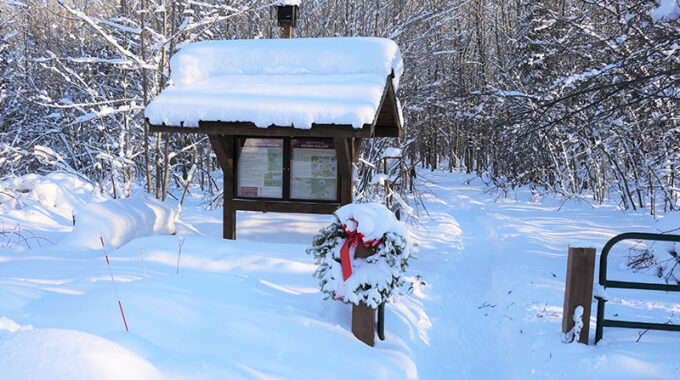
Wildlife employ a variety of strategies for surviving winter's snow and cold. If you know where to look, you'll discover that Beaver Hollow remains full of fascinating wildlife, even in the coldest months. Look carefully and you may spot a cavity, den, or lodge of a Beaver Hollow winter resident.
Our Accomplishments in 2026
We can’t revisit our 2026 accomplishments without acknowledging our many members who regularly donate their time and efforts to the organization. As a volunteer led organization, we depend on engaged community members to keep Beaver Hollow operational, the forests healthy for wildlife, the bird feeders filled, the restroom cleaned, the trails and boardwalk cleared, and the gardens looking great!

Last winter’s ice and wet snow loading was particularly hard on trees. On Earth Day, April 22, a group gathered at Beaver Hollow to remove fallen trees from public areas near the driveway and walkway. Other members collected trash along Compton Road as part of the Friends’ annual support of the Town of Russell’s Adopt a Town Road program.

These three volunteers pitched in to plant a new tree – an Ohio Buckeye! A large open area was left near the site entrance after several old apple trees succumbed to winter damage, and fell into the garden. Buckeyes are early bloomers so watch for the new tree to flower next spring.

Volunteers underplanted 450 young trees last May in year three of our 5-year black ash forest transition project, including 200 disease resistant Prairie Expedition American elm saplings, 200 swamp white oak whips, and 50 walnut seedlings. We will be planting again next May, so be sure and pencil in the weekend of May 7 and 8 to assist with tree planting at Beaver Hollow!

This past summer, the Friends hosted four engaging public programs at the Beaver Hollow pavilion. Attendees learned about unusual bird sightings on the peninsula, northern Wisconsin’s black bears, the beneficial effects of beavers on wetlands and water quality, and local wolves and coyotes. Just a reminder – residents can support a data collection project by reporting local wolf sightings using this form, https://form.typeform.com/to/QLAi4aWm.
Many thanks to the members who helped set up and take down each program—and especially to the member who supplied fresh-baked cookies for each event!

During a summer workday, volunteers cleared fallen branches along the Leopold Loop, trimmed the overgrown vegetation along the boardwalk to preserve ADA accessibility, weeded gardens, mowed grass, raked walkways, cleaned benches and signs, and generally tidied up the site for visitors.

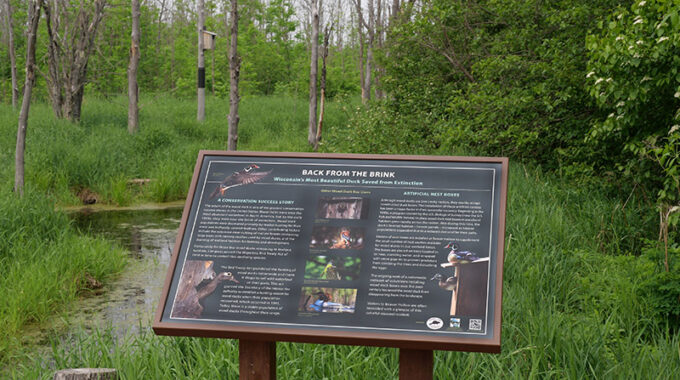
A Friends’ member with woodworking skills built six new wood duck boxes with rough sawn lumber generously provided by another member who owns a portable sawmill. The boxes will be mounted this winter when the boggy areas surrounding the wetland are frozen enough for travel. A piece of stove pipe tin will be wrapped around the tree below each box to deter nest predators. Once these new boxes are installed, there will be 24 total boxes in the wetland ready to host wood duck families. Wetlands are ideal habitat for wood ducks to raise their young, but often lack trees of sufficient size to support a duck-sized cavity.

Friends’ member citizen scientists gather twice each summer to engage in the Great Wisconsin Bat Count coordinated by the Wisconsin Department of Natural Resources (WDNR) to monitor summer bat populations and track their recovery from white-nose syndrome (WNS). It’s great news that our local bat populations have been increasing steadily in recent years after experiencing a steep decline following the introduction of WNS in Wisconsin.

Following the salvage of fallen and damaged trees from the June 2025 blowdown site, a Friends’ member with heavy equipment will bury exposed stumps, and crush and consolidate residual woody debris into piles to provide structural habitat for wildlife. Next spring, volunteers will be invited to plant fruit-bearing shrubs and mast-producing tree species to accelerate establishment of an early-successional forest community. Regeneration of this predominantly aspen stand is expected to increase forest structural and species diversity within the North Pikes Creek Wetlands and expand habitat for bird species dependent upon young forest conditions.

Members’ volunteer labor and financial contributions make year-round public access to the Beaver Hollow facility possible. In addition, Friends’ volunteers are carrying out a five-year forest stewardship project. Their work strengthens ecosystem resilience and preserves habitat for wildlife species that depend on the area’s forests and riparian communities, even as climate warming and widespread black ash mortality place these habitats under increasing stress.This volunteer supported initiative serves as an important demonstration project for both public and private forest managers in the northern Great Lakes region.
Related Posts