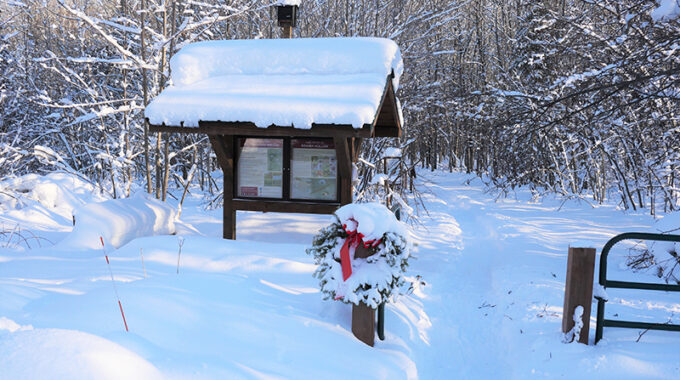
Wildlife employ a variety of strategies for surviving winter's snow and cold. If you know where to look, you'll discover that Beaver Hollow remains full of fascinating wildlife, even in the coldest months. Look carefully and you may spot a cavity, den, or lodge of a Beaver Hollow winter resident.
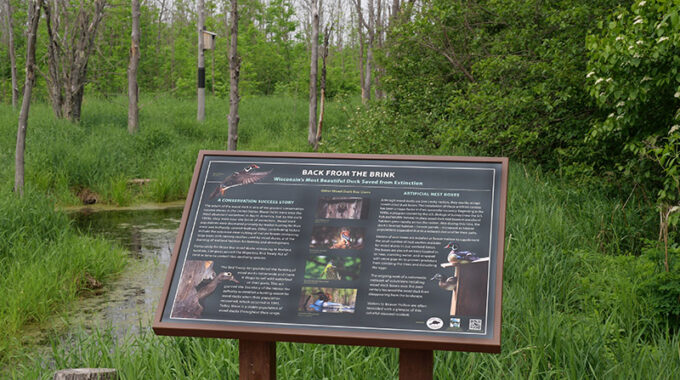
Interpretive Sign Installed on Second Boardwalk Platform
Newly installed sign recognizes the return of the Wood Duck
The return of the wood duck is a great conservation success story! Wood ducks were once the most abundant waterfowl in North America, but by the early 1900s, they were nearly extinct. Wood duck populations were decimated by market hunting for their meat and brilliantly colored feathers. Also contributing to their decline was habitat loss due to the clear-cutting of mature forests with large trees suitable for nesting cavities, and the draining of wetlands for farming and development.
The interpretive sign installed on the second boardwalk platform at Beaver Hollow tells the story of the near extinction and eventual recovery of the wood duck. In 1918, wood ducks received protection when Congress passed the Migratory Bird Treaty Act. To replace the natural nesting cavities that had been lost to logging, dedicated volunteers across the country built and installed hundreds of thousands of artificial wood duck boxes, significantly contributing to the wood duck’s recovery.
Note the wood duck box behind the sign in the photo above. In the past few years, volunteers have constructed and mounted dozens of wood duck boxes at Beaver Hollow. A few boxes have been erected near the boardwalk to demonstrate the best mounting method. The stove pipe wrapped around the tree prevents predators from climbing the tree and disturbing the wood duck eggs. Installing the box in water and away from other trees helps prevent squirrels from using the box.
The ash-dominated wetland forest surrounding the headwaters of North Pikes Creek has few large trees with cavities suitable for wood ducks. However, artificial nest boxes are readily accepted by the ducks and as a result, North Pikes Creek has become a virtual wood duck factory.
We extend our sincere thanks to the Natural Resources Foundation Quiet Trails Fund for granting funds to the Friends enabling us to design, print, and install this interpretive sign on the boardwalk, and 4 additional 6.5″x7.5″ interpretive signs along the Leopold Loop. Look for the new signs next time you walk the loop.

Related Posts